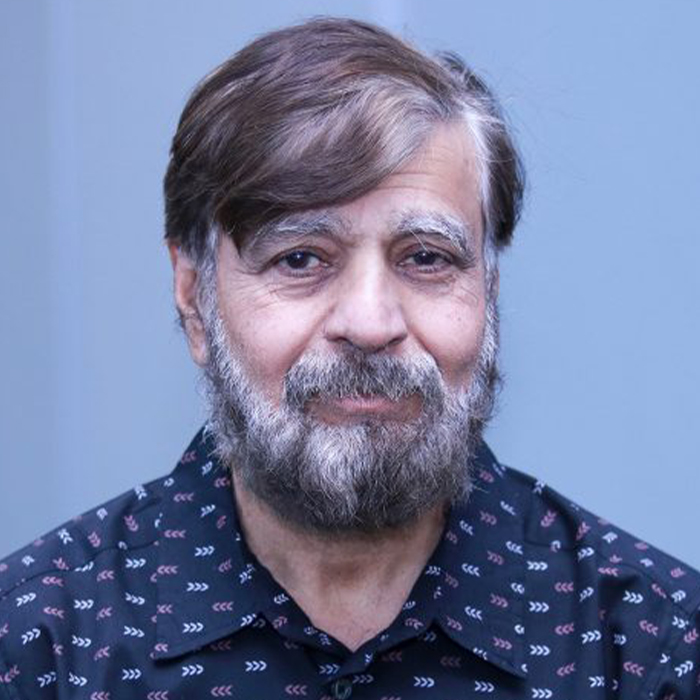
S. Ejaz Ahmed
@ BROCK UNIVERSITY
🌐 https://brocku.ca/mathematics-science/mathematics/directory/syed-ejaz-ahmed/
Day 1: 8:50-8:55 – Welcome Speech by the honorable conference chair
Day 1: 9:00-09:50 – From Sparsity to Weak Signals: Advances in Post-Shrinkage Modeling
Day 3: 15:40-16:00 — Closing Remarks and Announcement of Next Year’s HDDA conference by Honorable Chair
Abstract
In this talk, we present post-shrinkage strategies for high-dimensional statistical models in the presence of weak signals. In high-dimensional settings, numerous penalized methods have been developed for simultaneous variable selection and parameter estimation under sparsity assumptions. However, real-world datasets often contain not only a few strong signals but also many predictors with weak effects. In such situations, standard variable selection procedures may fail to adequately distinguish between strong and weak signals. To address this challenge, we propose a high-dimensional post-shrinkage strategy aimed at improving the predictive performance of candidate sub-models. We demonstrate that the proposed approach can outperform existing penalized and machine learning methods across a broad range of settings. Theoretical properties of the method are established through asymptotic analysis, while extensive numerical studies are conducted to evaluate its finite-sample performance. The results confirm the effectiveness of the proposed strategy and provide strong support for the theoretical findings. We further illustrate the practical utility of the approach through applications to high-dimensional datasets. Finally, the talk highlights several open research problems, discusses promising directions for future work, and presents some preliminary results.
Short Bio
S. Ejaz Ahmed (PhD 1987) is professor of statistics/data science. He is an internationally known scholar, educator, and an accomplished researcher. His research interests concentrate on big data, predictive modeling, data science, and statistical machine learning with applications in many walks of life. His research has been supported by a variety of grants from the Natural Sciences and Engineering Research Council (NSERC) of Canada since 1987, the Canadian Institute of Health Research, Ontario Centre for Excellence (OCE) and other sources throughout his academic career. He published more than 200 research articles in scientific journals and reviewed more than 100 books and travelled the globe doing 200 scholarly presentations.